
UK Areas With The Most Confusing Recycling Rules Revealed
Bromley has the most confusing household recycling guidance out of 58 major UK areas analysed, according to new research by Business Waste.
The study reviewed recycling pages from council websites and ranked areas using a “confusion score” based on the number of special instructions, the number of excluded items, and the readability of the guidance. Higher scores indicate more complicated household recycling rules.
Bromley ranked first with a confusion score of 71.9 out of 100, followed by Bristol, Enfield, York and Northampton. At the other end of the ranking, Birmingham had the least confusing recycling guidance, scoring just 7.7 out of 100.
The findings show how much recycling instructions can vary across the UK. In some areas, residents are given a short list of clear “yes” and “no” items. In others, everyday packaging can come with extra conditions around colour, lining, lids, cleaning, separation or container type.
The UK areas with the most confusing recycling rules
We analysed household recycling guidance from 58 major urban areas across the UK. The 10 areas with the highest confusion scores were:
- Bromley: 71.9 out of 100
- Bristol: 70.9 out of 100
- Enfield: 69.2 out of 100
- York: 68.8 out of 100
- Northampton: 66.3 out of 100
- Brent: 66.0 out of 100
- Richmond upon Thames: 62.9 out of 100
- Lewisham: 58.2 out of 100
- Southwark: 57.1 out of 100
- Wandsworth: 54.3 out of 100
Bromley came top after 81 separate recycling rules, and exclusions were counted across its guidance. Residents use different containers for paper, plastic, glass, cans and food, but some everyday items follow more specific rules. Tetra Paks go in the green box rather than the black paper box, while plastic plant pots are accepted unless they are black. Cut flowers can also go in the food waste container, but only if wrapped in newspaper or placed in a compostable bag.
Bristol ranked second, but for a slightly different reason. It had 108 rules and restrictions, the highest total in the study, but its wording was easier to read than some areas near the top of the list. Its guidance includes several preparation rules, such as shoes needing to be wearable, paired, tied together, dry and placed inside a labelled carrier bag before being recycled.
Enfield ranked third with 87 rules and exclusions identified. Residents are told to form aluminium foil into a fist-sized ball, rinse glass jars and replace their lids, and place shredded paper inside a paper bag. The council also warns that repeated contamination, after warning letters, could eventually lead to collections being stopped and a £60 fixed penalty notice.
York ranked fourth and had one of the lowest reading ease scores in the top 10. Its guidance includes item-specific rules, such as separating the plastic lid and cardboard body of a tube unless the tube has a foil lining, in which case it belongs in household waste.
Northampton completed the top five. One issue identified in the study was guidance around hard plastics, such as washing-up bowls. The council’s summary guidance directs residents to put these items in general waste, while its detailed plastics section says they should be taken to a household recycling centre.
Why recycling rules can feel confusing
Recycling decisions are often made quickly. A resident may be standing in a kitchen with packaging in their hand, deciding whether it goes in recycling, food waste or general waste.
Confusion can happen when the answer depends on small details, such as:
- Whether a plastic plant pot is black
- Whether cardboard is foil-lined
- Whether a lid should be removed or replaced
- Whether an item should be rinsed, squashed or bagged
- Whether a material goes in a kerbside bin or must be taken to a recycling centre
- Whether different property types follow different rules
This matters because confusion can lead to two problems. Recyclable materials may be thrown into general waste unnecessarily, while non-recyclable items may be placed in recycling bins and contaminate the load.
Mark Hall, Recycling Expert at Business Waste, said:
The UK areas with the least confusing recycling rules
The study also ranked the areas with the least confusing household recycling guidance.
The 10 lowest-scoring areas were:
-
- Birmingham: 7.7 out of 100
- Havering: 11.1 out of 100
- Haringey: 13.0 out of 100
- Hackney: 13.8 out of 100
- Plymouth: 17.7 out of 100
- Barking and Dagenham: 18.2 out of 100
- Edinburgh: 19.3 out of 100
- Greenwich: 21.8 out of 100
- Harrow: 23.3 out of 100
- Bexley: 26.1 out of 100
Birmingham had the least confusing recycling guidance overall. Across its recycling page, our researchers found eight special instructions and 15 exclusions, while its wording received the highest Flesch Reading Ease score in the study at 85.5.
Its guidance explains that paper and cardboard go in the removable pod, while plastic, metal and glass go in the main section of the recycling bin. Preparation rules, such as removing bottle tops and breaking down large cardboard boxes, are placed alongside the relevant materials.
Havering ranked second. Most household recycling goes into the same orange sack, including paper, cardboard, plastic packaging, glass, cans, foil and cartons. Its guidance also keeps preparation advice simple, asking households to rinse and squash recycling to save space.
Haringey had the fewest rules and restrictions in the study, with 11 counted in total. Its main guidance uses one mixed recycling list covering paper, cardboard, glass bottles and jars, tins, cans, aerosols and common plastic packaging.
What this means for businesses
The research is based on household recycling guidance, but the same issue affects workplaces.
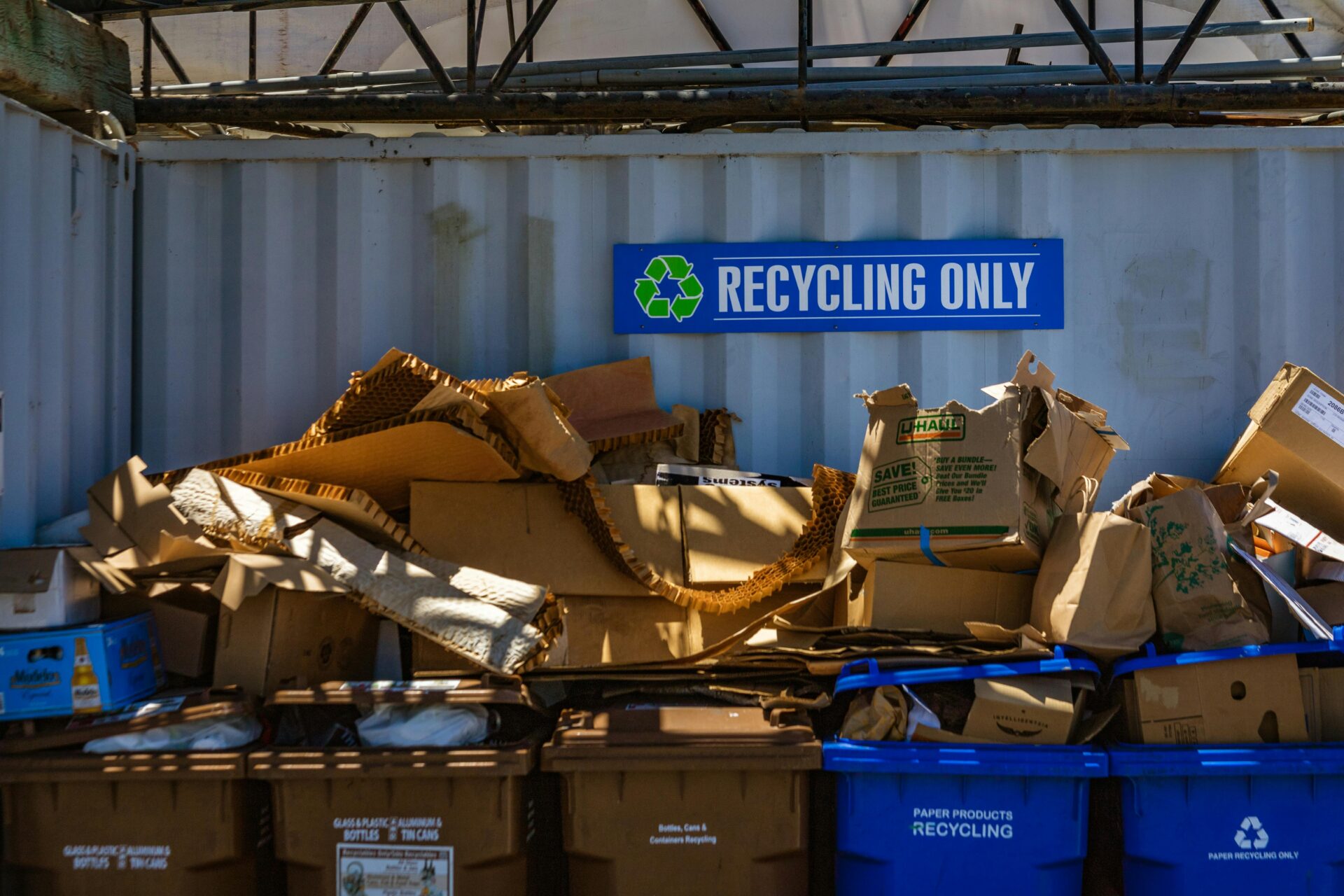
In busy commercial environments, staff often make quick decisions about what goes in each bin. If workplace recycling points are unclear, recyclable materials can end up in general waste, while food waste, liquids, batteries, vapes, electrical items or contaminated packaging can end up in the wrong recycling stream.
For businesses, this is more than an inconvenience. Poor separation can lead to contamination, rejected loads, extra costs and weaker recycling performance.
This is especially important under Simpler Recycling in England. Most workplaces in England need to arrange separate collections for dry recyclable materials, food waste and non-recyclable waste, while micro-firms have until March 31st, 2027 to meet the requirements.
Businesses can reduce confusion by:
- Keeping bin labels simple
- Using real examples from the workplace
- Placing bins where waste is produced
- Separating food waste from dry recycling
- Keeping paper and cardboard clean and dry
- Training staff when recycling rules change
- Reviewing contamination with their waste provider
The goal is not to make staff read long recycling guidance. It is to make the correct bin choice obvious at the point where waste is thrown away.
How recycling guidance could be clearer
The least confusing areas in the study tended to make recycling easier by keeping guidance short, direct and grouped around familiar bin types.
Clearer recycling guidance should:
- Keep core rules on one current page
- Use consistent names for bins and containers
- Put exemptions next to the item they relate to
- Use plain English rather than technical material names
- Include clear photographs of common packaging
- Explain preparation rules where they matter
- Avoid sending users through several pages for everyday items
This does not mean every council can collect the same materials in the same way. Recycling infrastructure, collection systems and treatment routes vary. But even where local rules differ, the wording can still be clearer.
Need simpler recycling at work?
We help UK businesses arrange commercial waste and recycling collections, including general waste, dry mixed recycling, cardboard, glass, food waste and specialist waste streams.
Clear bins, simple labels and the right collection setup can help reduce contamination and make recycling easier for staff. Get a free quote for commercial waste collection today.
Methodology
Business Waste analysed household recycling guidance from 58 major urban areas across the UK.
The areas were selected from Investment Monitor’s list of the UK’s largest cities as a starting point, before being expanded to include all 32 London borough councils.
Our research counted:
- Special instructions residents were expected to follow, such as rinsing containers, removing lids or using a particular liner
- Items and material categories explicitly excluded from household recycling bins
- The readability of relevant guidance, using Flesch Reading Ease
Instructions, exclusions and readability were each scored from 0 to 100 and given equal weighting. The three component scores were averaged to produce the final confusion score. A higher score indicates more complicated published guidance.
Repeated rules were counted once. Collection dates, prices, missed-collection information and other administrative guidance were excluded.
The study measures the complexity of councils’ published online guidance. It is not intended to critique the quality of their recycling services. It is also not a comprehensive review of every UK council, but a snapshot of major UK urban areas.
Data was collected on August 13th, 2026 and is correct as of then.


Have your waste collected
Get a fast FREE quote for your waste collection 0800 211 83 90
- Free quote within 1 hr
- Any type of waste
- FREE bins and delivery
- We cover all of the UK